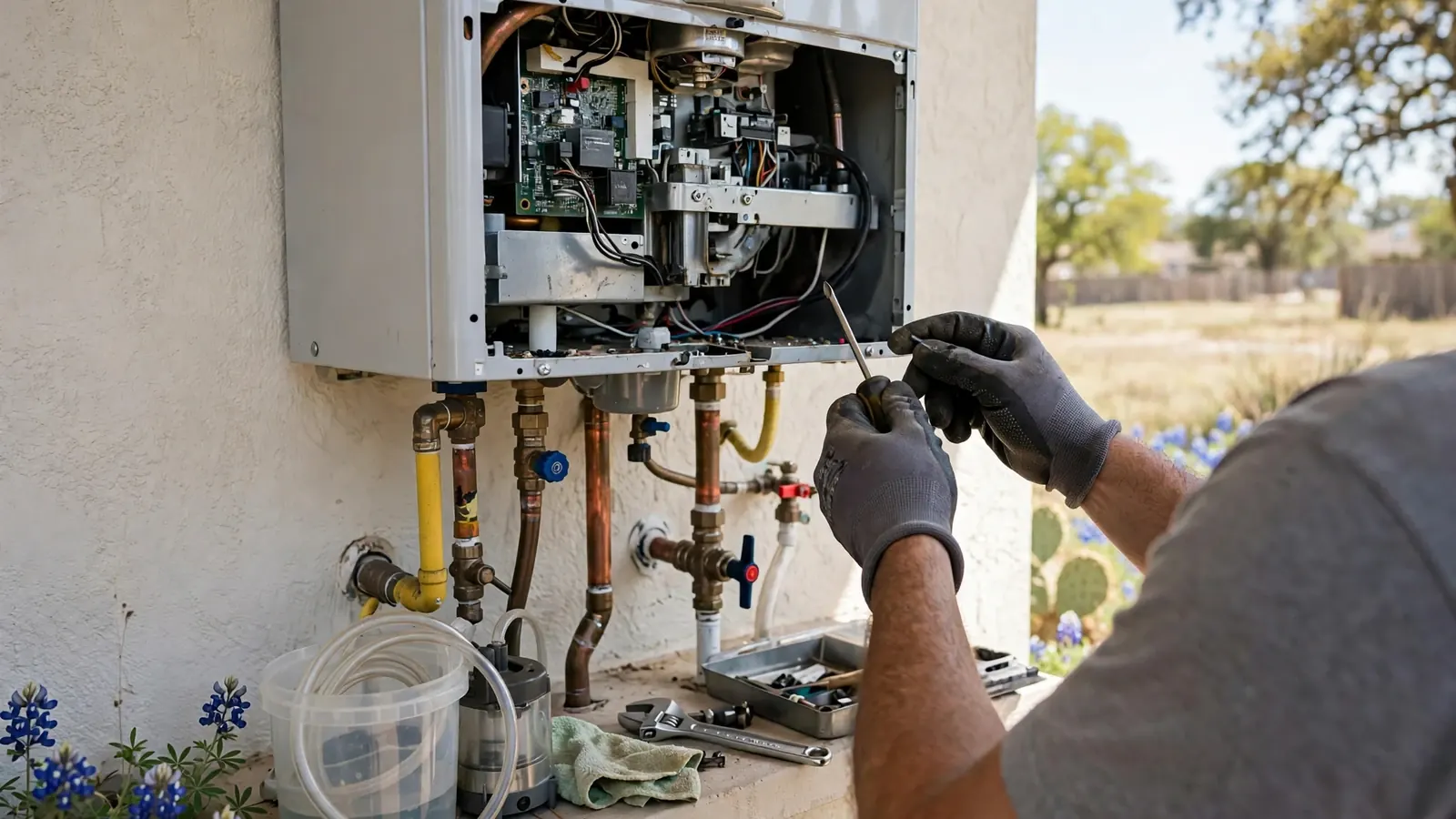
Many older homes in and around Maywood, IL are heated by a boiler that feeds radiators or baseboards, and the question comes up when the water heater needs replacing: can a tankless unit work alongside the boiler, or should the boiler do both jobs? The answer depends on the boiler's age, the gas supply and how much hot water the household uses.
There are three common setups. You can keep the boiler for heat and a separate tank for hot water, put in a tankless unit for hot water, or switch to a combination boiler that does both. Each has a different cost, footprint and maintenance routine.
The three setups compared
| Setup | How it works | Best fit | Watch for |
|---|---|---|---|
| Boiler plus tank | Boiler heats the house, a separate tank heats water | Homes with a working boiler and a basement | Two appliances to maintain. |
| Boiler plus tankless | Boiler heats the house, a wall-hung tankless unit heats water | Homes that want continuous hot water and floor space | Gas line size and venting. |
| Combination boiler | One unit makes heat and hot water | Homes replacing an old boiler | Higher upfront cost, one point of failure. |
None of these is always best. The right one depends on what is already in the house and what you plan to replace first.
Adding a tankless unit to a boiler house
A tankless heater needs a bigger gas line than a tank because it burns more fuel at once. In a house where a boiler and a tank share a line, adding a tankless unit may mean upgrading the gas pipe or running a new branch. The plumber calculates the combined load before recommending anything.
Venting is the other issue. A tankless unit needs its own vent path, and in a basement with a masonry chimney that is already serving the boiler, the new unit may need a separate stainless or plastic vent. See tankless water heater service for what the install involves.
Combination boilers: one unit, two jobs
A combination boiler heats radiators and makes hot water on demand with a second heat exchanger. It saves floor space and can be efficient, but it ties both heat and hot water to a single machine. If it fails in January, you lose both.
Replacing an old boiler is the natural moment to consider one. If your existing boiler is still sound, keeping it and adding a separate hot water source is often cheaper and keeps the systems independent.
Questions that decide the setup
- How old is the boiler, and does it have repairs coming?
- How much hot water does the household use at peak?
- Is there floor space for a tank, or is a wall unit needed?
- Can the gas line handle the added load?
- Is the vent path available for a new unit?
- Which failure would hurt more, no heat or no hot water?
Maintenance for each setup
A boiler wants an annual service before heating season. A tank wants a flush and an anode check. A tankless unit wants periodic descaling. Combining the schedule into one yearly visit saves effort.
If a tankless unit sits on a boiler house, ask for isolation valves so it can be flushed easily. For boiler problems, see boiler repair. For tank replacement, see water heater replacement.
Cost and payback, honestly
Tankless and combination systems cost more up front than a tank. Savings come from lower standby loss and, in some systems, higher efficiency, and they depend on how you use hot water and on what gas costs. Ask for the installed price and the manufacturer's efficiency rating, and decide on that basis instead of a general claim.
If your boiler is already failing, replace the biggest problem first. A new tankless unit on a failing boiler is a poor use of money.
Sizing the gas supply for two appliances
A boiler and a tankless unit may both run at the same time on a cold morning, when the house is calling for heat and someone is in the shower. The gas line has to feed both without a drop in pressure, or one of them will shut down on a fault.
The plumber adds up the input rating of every gas appliance on the line, then compares it with what the pipe and the meter can deliver. The pipe length and the number of fittings matter as well. A long run of half-inch pipe that served a tank and a boiler for decades may not support a tankless unit.
If the line is too small, the fix is usually a new, larger branch to the new unit, not a full replacement of the house's gas piping.
Planning the replacement order
When both the boiler and the water heater are old, replace the one that is closer to failing and plan the other. A boiler that is more than twenty-five years old may need parts that are no longer made. A tank water heater past ten years has a leak risk.
Making the decision once, with a plumber who has seen both, avoids buying a new tankless unit and then learning that the boiler needs a bigger vent or a new chimney liner. The two systems often share a chimney, and a change to one affects the other.
Standards for gas appliances
Both appliances draw on gas and vent products of combustion, so NFPA 54, the National Fuel Gas Code, and the manufacturer's listed vent instructions apply. Carbon monoxide alarms near bedrooms are also required in Illinois.
Maywood housing and hot water
Maywood was organized as a village in 1881, and the Maywood Company began building houses in the early 1870s. Older housing from that period often has steam or hot water heat added later, with the boiler in the basement, which is why the question of a tank, tankless or combination setup comes up so often here.
Maywood buys its water from Chicago, and the village's annual water report is available from the village. It does not state a hardness figure, so a water test is the way to learn whether a tankless unit will need frequent descaling.
Sources: Village of Maywood history and annual water quality report.
Deciding between tank, tankless and combination? Call for a plan.
Call (855) 575-2890Tankless and boiler questions in Maywood
Yes, with an indirect tank or a combination boiler. The best option depends on the age of the boiler and your use.
Often, but the gas line and the vent path decide it. A plumber checks both.
It saves space but ties heat and hot water to one machine. It suits homes replacing an old boiler.
The village's annual water report. It does not give hardness, so test your tap.
Yes. See Melrose Park and Oak Park.
Planning a hot water change? Call us. Call (855) 575-2890