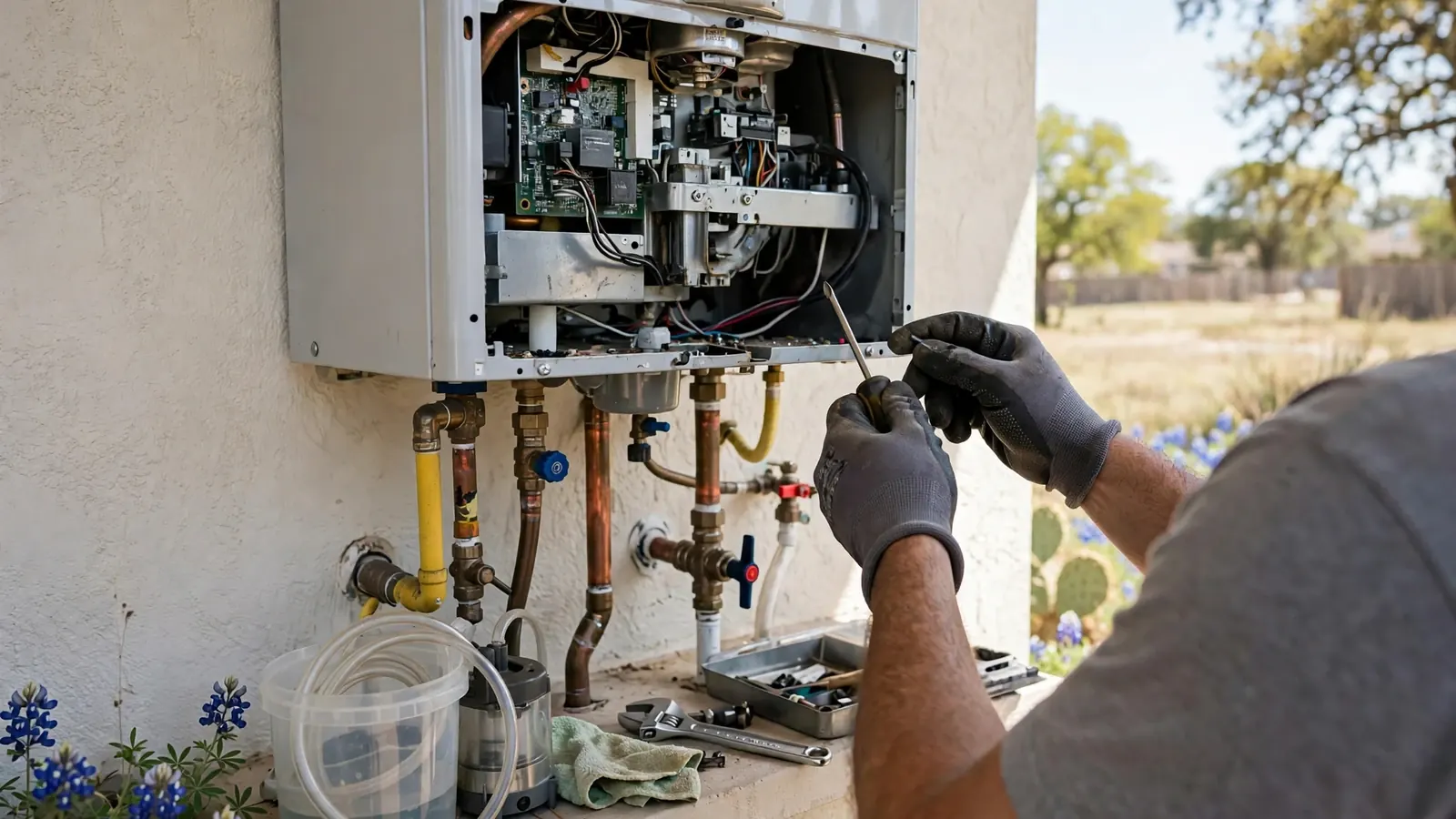
A tank water heater keeps a large volume of water hot all day, even when nobody is home, and loses some heat through its walls. A tankless unit heats water only when a tap is open, which removes most of that standby loss. That is where the energy savings come from.
Savings are real, but they vary. The more often the house is empty and the less hot water you use, the more a tankless unit can save compared with a tank. This guide helps homeowners in Maywood, IL weigh the savings against the extra cost of the unit and the work to install it.
Where the savings come from
Standby loss is the heat a tank loses while it holds hot water. A tankless heater has almost none. The savings are larger in a house that uses little hot water for most of the day, such as a couple working away from home, and smaller in a busy household that uses hot water constantly.
Efficiency ratings help compare models. Look at the uniform energy factor on the label, which is a standard rating for water heaters, and compare it with the tank you would otherwise buy.
Costs that eat into the savings
| Cost | Why it applies | How to handle it |
|---|---|---|
| Higher unit price | Tankless units cost more than tanks | Compare installed prices. |
| Gas line upgrade | Tankless burns more fuel at once | Have the plumber size the line. |
| Venting | Needs its own vent route | Plan the route early. |
| Descaling | Scale cuts efficiency | Flush on schedule. |
| Electrical | Needs power for the fan and controls | Check for an outlet. |
Add these up honestly. A tankless unit that needs a new gas line and a new vent may take many years to pay for itself, and some never do.
A simple way to estimate
- Find your current costUse your gas or electric bills and estimate how much goes to water heating.
- Find the efficiency gapCompare the uniform energy factor of a tank and the tankless unit you are considering.
- Estimate the savingApply the gap to your water heating cost for a rough yearly saving.
- Add installation extrasInclude any gas, vent and electrical work.
- DivideDivide the extra cost by the yearly saving to estimate payback in years.
Other reasons to choose tankless
Savings are not the only reason. A tankless unit never runs out of hot water in a long shower, it takes less space and a well maintained unit often lasts longer than a tank. Those are real benefits even if the energy saving is modest.
Reasons to keep a tank include a lower upfront cost, simpler installation and the ability to supply hot water during a short power outage, since many tankless units need electricity. See tankless water heater service and water heater replacement to compare.
Keeping the savings over time
Maintenance that preserves efficiency
- Flush the unit on the maker's schedule.
- Keep the air intake and vent clear.
- Clean the inlet screen when flow drops.
- Set the temperature no higher than you need.
- Fix hot water leaks quickly.
A worked example, in plain terms
Suppose a household spends a certain amount per year heating water with a tank. A tankless unit that is, say, a fifth more efficient would cut that amount by about a fifth. If the water heating bill is modest, the saving is modest too, and a high installed price makes the payback long.
If the household spends heavily on hot water and the tank is old and inefficient, the same improvement is worth more. The percentage is the same, but the base is larger. That is why the honest answer to how much a tankless unit saves is that it depends on how much you spend now.
Use your own bills, not an average. Pull twelve months of gas or electric bills, estimate the share spent on hot water and apply the efficiency gap.
Other savings that are easy to miss
Lowering the thermostat on any water heater to a safe, comfortable setting saves energy and reduces scald risk. Insulating hot water pipes in the basement helps too, as does fixing a dripping hot tap, which wastes both water and heat.
Low-flow showerheads reduce hot water use directly, and they work with either a tank or a tankless unit. These steps cost little, and for many households they save as much as a new heater would.
Rebates, tax credits and incentives
Some utilities and governments offer rebates or credits for high efficiency water heaters. These programs change often and have eligibility rules, so check current terms before you buy. A rebate can shorten payback considerably, but only if the unit you choose qualifies.
Ask your plumber which models meet the program's efficiency rating, and keep the invoice and the model's label for the paperwork. Do not count on an incentive that you have not confirmed in writing.
If an incentive is available, it is one more factor in the payback arithmetic, not a reason to choose a unit that does not suit the house.
How long a tankless unit lasts
Many tankless heaters are rated for fifteen to twenty years, longer than most tanks, when maintained. That longer life improves the math, because the higher price is spread over more years and you avoid replacing a tank once or twice in the same period.
The life depends on water quality and care. Scale shortens it, and so does neglect. Budget for periodic flushing.
Local context for Maywood households
Maywood's housing runs from older homes built after the Maywood Company began development in 1868 to later construction. The village's population was 23,512 at the 2020 census. The age of your house decides how much work the gas line and venting will need, which drives the payback more than any rating.
Maywood buys its water from Chicago, and the annual water report does not state a hardness figure. Because scale reduces a tankless unit's efficiency, test your tap before relying on a published payback estimate.
Sources: U.S. Census Bureau 2020 count for Maywood and Village of Maywood annual water report and history.
Want a straight payback estimate for your house? Call us.
Call (855) 575-2890Tankless energy questions in Maywood
Often yes, mainly by avoiding standby loss. How much depends on your hot water use.
Savings are modest, but a low-use household also pays less to heat water in the first place. Payback can be long.
Scale on the heat exchanger and a blocked vent or air intake.
Often yes. The plumber calculates the load first.
Thinking about tankless? Call for a plan. Call (855) 575-2890