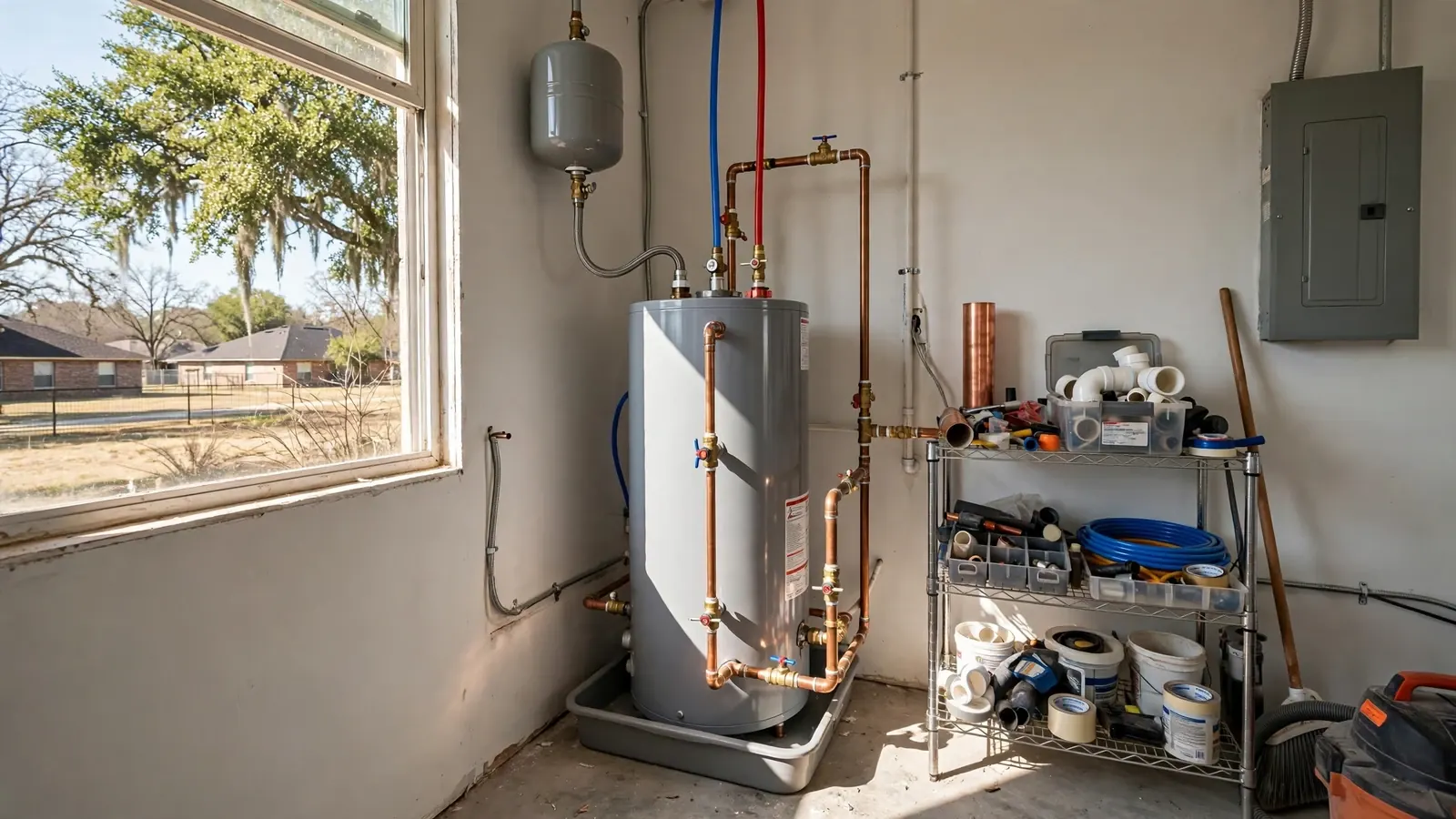
A thermal expansion tank is a small tank with an air cushion inside, connected to the cold water line near the water heater. When the heater warms a full tank of water, the water expands slightly. The expansion tank absorbs the extra volume so pressure does not spike in the pipes, the relief valve and the heater itself.
Homeowners in Maywood, IL most often ask about expansion tanks when a new water heater is going in, or when the relief valve starts dripping. The tank is inexpensive, but putting it in correctly matters, because a waterlogged or misplaced one does nothing.
Why a closed system needs one
Many houses once had an open system, where expanding water could push back toward the street through the service line. Backflow preventers, pressure reducing valves and check valves on modern service lines close that path. The water then has nowhere to go but into the pipes, and pressure rises each time the heater cycles.
Repeated pressure spikes strain fittings, shorten the life of the heater and make the temperature and pressure relief valve drip. If your relief valve weeps after every heating cycle, a failed or missing expansion tank is a likely cause.
Sizing and setting the air pressure
Expansion tanks are rated by volume, and the right size depends on the water heater's capacity and the house water pressure. A tank for a 40-gallon heater is small, and larger heaters need larger tanks. The label on the tank gives the pre-charge, which must match the house pressure.
Check the air pressure on the tank's valve with a gauge before installing, and set it to match the incoming water pressure. A tank charged to the wrong pressure fills with water and stops working.
| Item | What to check | Why it matters |
|---|---|---|
| Tank volume | Matches heater size | Too small cannot absorb expansion. |
| Air pre-charge | Matches house pressure | Wrong charge makes it waterlogged. |
| Mounting | Supported, not hanging on the pipe | Prevents stress on fittings. |
| Location | Cold line near the heater, with a tee | Keeps hot water from reaching it. |
Installation steps
- Shut off the water and powerClose the cold supply, switch off power or gas and open a hot tap to relieve pressure.
- Install a teeCut into the cold line near the heater and add a tee for the tank.
- Set the pre-chargeMatch the tank's air pressure to the house pressure.
- Mount and connectThread the tank on, support it and tighten without overstressing the fitting.
- Restore and testOpen the supply, bleed air from a tap, check for leaks and watch the pressure gauge through a heating cycle.
Signs your expansion tank has failed
Failure signs
- Water comes out of the air valve when you press it.
- The tank feels heavy or full all over when tapped.
- The relief valve drips after heating cycles.
- Pipes bang when the heater fires.
- House pressure climbs when no water is used.
- The tank is more than eight to ten years old.
Related work
An expansion tank is part of a proper installation. If you are replacing a heater, see water heater replacement and water heater installation. If the relief valve is already dripping, water heater repair finds the cause.
How to check an existing expansion tank
Look for the tank near the water heater, on the cold line. It is a small tank, often blue or gray, with a tire-style valve on the bottom or the side. Press the valve briefly. Air should come out. If water comes out, the diaphragm inside has failed and the tank is waterlogged.
Tap the tank with a knuckle. The top half should sound hollow, and the bottom should sound solid if water is present. A tank that sounds solid all over has lost its air cushion.
Turn off the water and drain the tank's pressure before replacing it. Never remove an expansion tank while the line is under pressure.
Pressure reducing valves and thermal expansion
Many houses have a pressure reducing valve where the water line enters. It protects fixtures from high street pressure, but it also closes the system and makes thermal expansion a problem. If the house pressure is above about eighty psi, a gauge on a hose bib will show it, and the valve may need adjusting.
A plumber can check the house pressure, test the valve and size an expansion tank in one visit. Fixing a high pressure problem protects every fixture in the house, not just the water heater.
What happens if you skip it
Without a working expansion tank on a closed system, every heating cycle raises pressure. Over months, the pressure fatigues the tank's seams, the relief valve and the fittings on every fixture. Washing machine hoses and toilet fill valves are often the first to leak.
A water heater's warranty may also exclude damage from thermal expansion when no tank was installed. A small tank is cheap protection for a larger investment.
Where the tank should be mounted
The tank can sit vertically on the cold line, either hanging from the pipe or supported from below. Most makers prefer a support under or beside a heavier tank, so the pipe does not carry the weight. Keep it where you can reach the air valve.
Do not install it on the hot side, where heat can damage the diaphragm. A plumber will mark the cold line and use a proper fitting.
What the model codes require
Model codes such as the UPC and the IPC call for thermal expansion control on a closed water system, and a pressure relief valve is a standard safety part on every tank. Illinois applies its own plumbing code, with the same goal.
What to do before you work on the tank
Expansion tank safety steps
- Shut off the power or gas to the water heater first.
- Close the cold supply and relieve pressure at a hot faucet.
- Let hot water cool before opening any fitting, to avoid scalds.
- Never plug or cap the pressure relief valve.
- Call a plumber if the relief valve drips or the tank rumbles.
Permits for water heater work in Maywood
The Village of Maywood building department says an inspector is assigned once a permit application is complete, that the first review takes about three business days and that most projects need two formal reviews. If the expansion tank is part of a new heater installation, ask whether the work falls under a permit.
Maywood buys its water from Chicago. Ask your plumber to check your house pressure with a gauge before choosing the tank's pre-charge.
Sources: Village of Maywood building department and Village of Maywood annual water report.
Relief valve dripping? Call us.
Call (855) 575-2890Expansion tank questions in Maywood
Where the system is closed, yes, and many codes require it. A plumber can tell you.
Often eight to ten years. A tank can fail sooner if the pre-charge was wrong.
It is a modest plumbing job. If the water must be shut off and the heater drained, many homeowners prefer a plumber.
Pressure may be rising because the expansion tank has failed, or the valve itself is worn.
Yes. See Melrose Park and Forest Park.
Need a tank installed or checked? Call us. Call (855) 575-2890