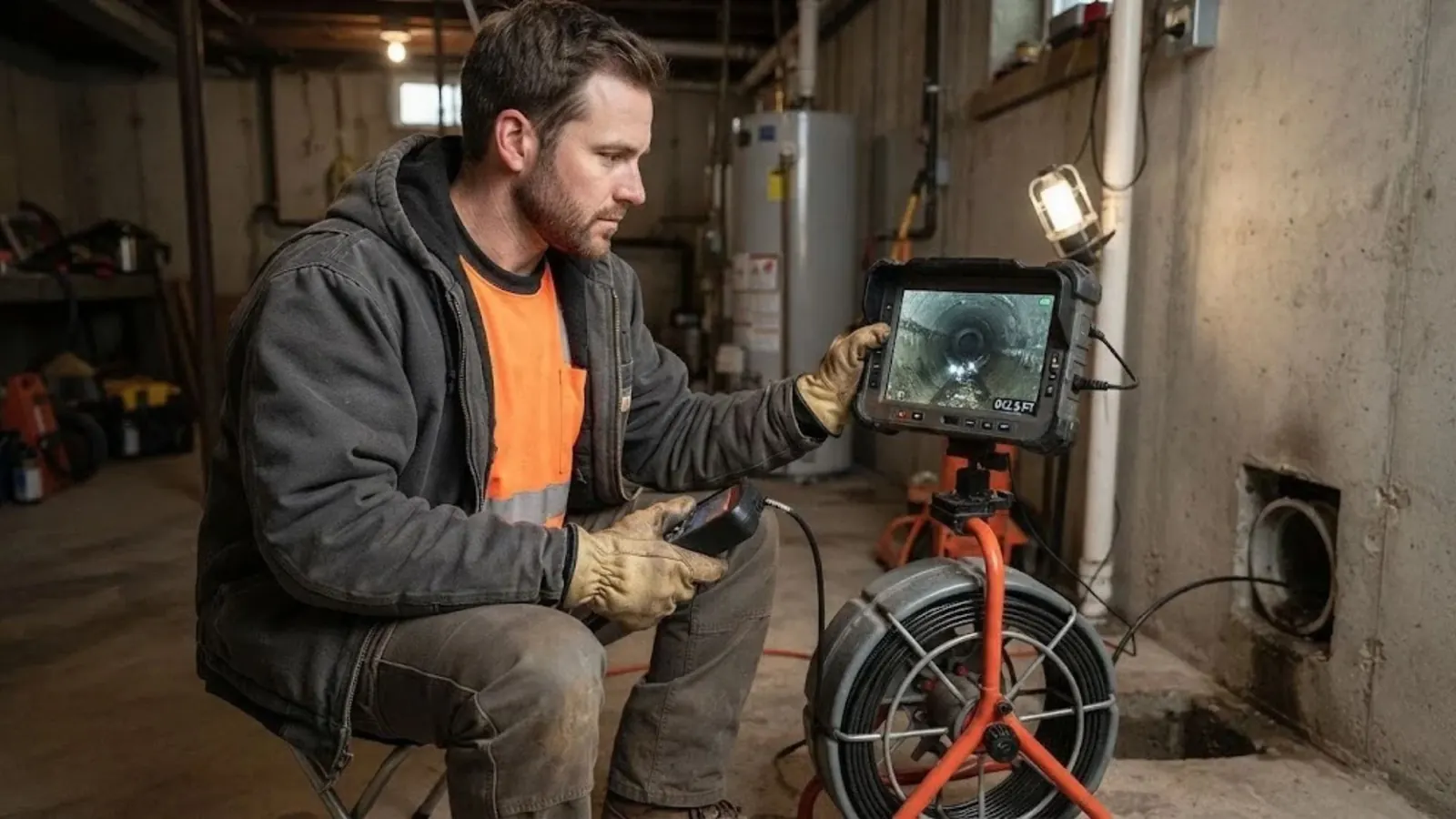
Sewer inspection in Maywood, IL uses a waterproof video camera on a flexible cable to look inside the main drain and the sewer line to the street. The plumber sees cracks, root intrusion, offsets, sags, scale and blockages, and records the video for you.
The inspection is useful in three situations: after repeated backups, before buying an older house and before deciding on a repair or lining job. Guessing at what is inside a buried pipe leads to repairs that miss.
When to inspect the sewer line
Reasons to run a camera
- Repeated backups or slow drains in several fixtures.
- Gurgling sounds from toilets or floor drains.
- A sewer smell in the basement.
- Buying a house with a main drain that is decades old.
- After a root clearing, to see what the roots left behind.
- Before a lining or excavation job, to map the pipe.
What the camera can find
| Finding | What it looks like | Typical next step |
|---|---|---|
| Root intrusion | Fine roots or a mass at a joint | Cut the roots, then repair or line. |
| Cracked or broken pipe | Visible fracture or missing section | Sewer line repair. |
| Offset joint | Pipes that no longer line up | Excavate or line. |
| Belly or sag | Low spot where water pools | Repair the section. |
| Scale or grease | Rough buildup on the walls | Hydro jetting. |
| Collapsed pipe | Blocked view, flattened pipe | Excavation and replacement. |
Why it matters in Maywood
Maywood's hazard plan lists basement backups from undersized sewers and a combined sewer area near I-290. The village's own sewer system is separate from the pipe that serves your house, but a problem in your lateral can add to the effect when the public sewer is full.
In 2022 the village repaired 19 sewer structures, which shows how much of the system needs attention. The lateral from your house to the street is your responsibility, and an inspection tells you whether it is part of the problem.
What an inspection involves
- Access the lineThe camera goes in through a cleanout, a pulled toilet or a floor drain.
- Record the runThe plumber drives the camera through the line and records the video.
- Mark problemsLocators pinpoint the depth and position of any trouble above ground.
- Review the footageYou see the video and get a plain explanation of what it shows.
Using the results
A clean pipe needs no work. A pipe with roots or grease may need cleaning, and a pipe with a break needs repair. If the damage is spread out, lining the pipe from the inside may avoid digging up the yard, and replacement is the option when the pipe has collapsed.
If the camera cannot pass because of a blockage, the line is cleared first. See sewer line cleaning and drain cleaning.
Reading the video with the plumber
A camera shows the inside of the pipe, but the picture needs interpretation. A shadow can be a stain, a joint or a crack, and the plumber marks the footage with the distance from the cleanout so you can find the same spot later.
Ask for the footage in a format you can keep. If you are buying a house, send it to your inspector. If you are repairing, send it to every contractor who bids, so each quote covers the same pipe.
A short written note with the pipe material, diameter and the depth of any defect makes the file useful years later, when a different plumber works on the same line.
Inspection before buying an older house
A home inspector looks at the visible plumbing, but the sewer lateral is buried and often original. In an older village a failed lateral can turn into a repair far larger than a water heater or a faucet.
Schedule the camera visit during the inspection period so you can ask for a credit or a repair if the pipe is damaged. Give the plumber access to the cleanout, or tell the seller that a toilet may need to be pulled.
Standards for sewer camera work
Sewer inspections follow industry guidelines such as the NASSCO pipeline coding system for defects, and any repair follows the Illinois Plumbing Code. Recording the defect by type and distance lets a second contractor read the same finding.
What to do before we arrive
Before a sewer camera visit
- Stop using water and do not flush if the drain is backing up.
- Locate the cleanout cap and clear the space around it.
- Do not pour chemicals down a backing up drain.
- Keep children and pets away from sewage on the floor.
- Note when the backup started and which fixtures are affected.
Camera inspections in our ZIP codes
Sewer camera visits run in Maywood 60153, Bellwood 60104, Broadview 60155 and Forest Park 60130. Buyers of older homes in these villages often book an inspection before closing, and the video becomes part of the negotiation.
What changes the price of a sewer inspection
A camera inspection is a diagnostic visit priced by time and access.
For a home purchase, an inspection can save you from an expensive surprise. Want your real number? Call (855) 575-2890.
Want to see what is in your sewer line? Call us.
Call (855) 575-2890Sewer inspection questions in Maywood
Often under an hour for a typical house line, longer if the line must be cleaned first or is long.
You should. Ask for the video and notes when you book.
It is a smart step for an older house. Many Maywood homes date from well before 1950, and the sewer lateral may be original.
Yes. It shows what is blocking the line, and the plumber can clear it afterward.
It is a planned service. If you have a backup right now, see sewer line cleaning.
Need a camera inspection? Call us. Call (855) 575-2890