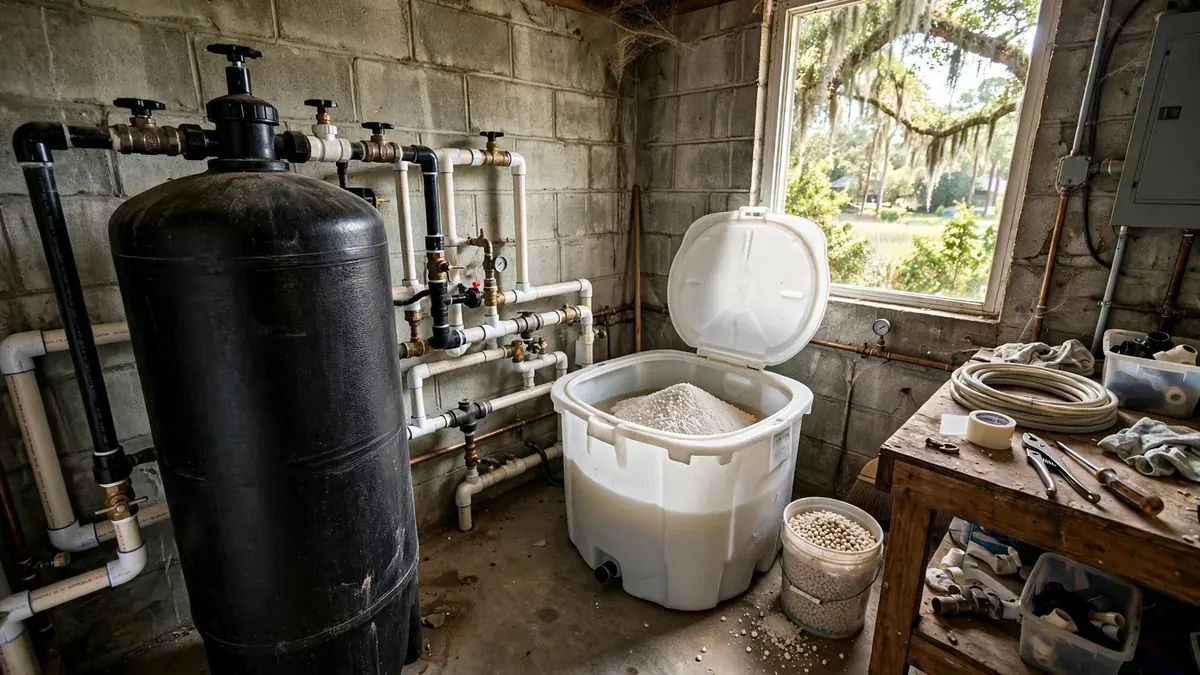
Water softener and filtration service in Maywood, IL covers installing and servicing softeners, whole house filters, under sink filters and reverse osmosis systems. The right equipment depends on what is in your water, and what is in your water depends on the source and on your pipes.
Maywood buys its water from Chicago, which draws from Lake Michigan. The village's annual water report does not publish a hardness figure, so this page does not state one. A simple test at your tap, or a lab test, gives you the real number for your house.
Test your tap before you buy
Hardness test strips are inexpensive and give a rough reading. A lab test gives exact numbers for hardness, iron, chlorine and other items. Do the test before you buy equipment, because a softener is built for hardness, while filters handle taste, chlorine and sediment.
If you want to check lead, ask the village water department about testing. The village's report lists a lead 90th percentile of 5.82 ppb from samples collected in August 2021, below the 15 ppb action level, but your own plumbing can add lead. Older fixtures, solder and service lines are the usual sources.
- Collect a sampleUse a clean container and run the cold tap for a minute first.
- Test hardnessUse strips or send a sample to a lab.
- Decide the goalHardness, taste, chlorine, sediment or lead concerns each point to different equipment.
- Choose equipmentMatch the system to the result and the household's use.
Which system for which problem
| Problem | System | Notes |
|---|---|---|
| Hard water scale | Salt-based softener | Needs a drain and salt refills. |
| Chlorine taste and odor | Carbon filter | Whole house or under sink. |
| Sediment | Sediment filter | Replace cartridges on schedule. |
| Drinking water quality | Reverse osmosis | Under sink, slower, has a waste line. |
| Lead concerns | Certified filter, plus fixing the source | Check that the filter is certified for lead. |
What installation involves
Most systems go on the main line after the meter. The plumber needs a drain nearby for a softener, an electrical outlet and enough floor space. Bypass valves let you service the unit without shutting off the house.
Because the unit connects to the main supply and to a drain, it should be installed to code, and an air gap on the drain line keeps wastewater from siphoning back.
Maintenance and what to expect
Keeping the system working
- Add softener salt on schedule.
- Replace filter cartridges at the interval the maker gives.
- Sanitize the system after any long off period.
- Test the water again after installation to confirm the result.
- Check for leaks at the connections and the drain line.
- Service the unit once a year.
Related plumbing
A softener protects water heaters and fixtures from scale, and a new system is a good time to review water heater installation and the age of the pipes. If you see rust in the water or low pressure, repiping may address the real cause.
Reading a water test
A hardness result is usually given in grains per gallon or milligrams per liter. Strips give a rough band. A lab gives a number you can use to set a softener and to decide whether you need one at all.
Do not buy a system based on someone else's water. Your neighbor's reading may differ from yours, since old plumbing, a softener already in the house or a different service line can change the result.
If you want to look at lead, ask the village water department or a certified lab for a first-draw sample. That test tells you about the fixtures and lines in your own house.
Drinking water filters versus whole house systems
A whole house filter treats every tap, which helps with chlorine taste and sediment in laundry and showers. It costs more and needs larger cartridges. An under sink or countertop filter treats only the drinking and cooking water, and it is cheaper to start and to maintain.
Choose a filter certified by an independent body for the contaminant you care about. A label that only says the cartridge reduces taste and odor does not mean it removes lead.
Standards for softeners and filters
Look for NSF/ANSI 44 on a cation exchange softener and NSF/ANSI 53 on a filter that claims health related reduction. The Illinois Plumbing Code also requires an air gap on the softener drain line.
Water treatment visits
Water testing and treatment installs are scheduled in Maywood 60153, Melrose Park 60160 and Broadview 60155. Each village buys its water through Chicago, so the useful test is the one at your own tap.
What changes the price of water treatment
The equipment and the installation are priced separately, and the right choice depends on the test result.
Be wary of a sales pitch that skips testing. Ask what number the system is meant to change. Want your real number? Call (855) 575-2890.
Want your water tested and a system sized? Call us.
Call (855) 575-2890Water softener and filtration questions in Maywood
The village's report does not give a hardness figure, so test your tap or ask the village water department.
Only if your test shows hardness at a level that causes scale or soap problems. A test tells you.
Only a filter certified for lead removal works. Also check the source, such as a service line or old fixtures. See water service line.
The village purchases water from Chicago, per its annual water report.
Softened water reduces scale, which helps a water heater and a tankless unit last longer.
Questions about your water? Call us. Call (855) 575-2890